CodeWolf
Open-source AI code reviewer for pull requests, as a CLI and a GitHub Action.
not yet reviewed by publik. It is live now; the founder has not reviewed this version yet.
by 
How to install CodeWolf
Every step written out. No terminal experience needed. Pick your setup.
README
Open in GitHub

CodeWolf
It eats rabbits.
Open-source AI code review for pull requests and local changes.
Bring one API key, many keys at once, a local model, or your Claude subscription.
CodeWolf reviews a diff and gives you a summary, a per-file walkthrough, and line-by-line findings with ready-to-apply fix suggestions. It runs in three places:
- CLI:
codewolf reviewon your working tree, a branch, or a patch file. Built for humans and for coding agents. - GitHub Action: posts a summary comment and inline review comments on every pull request, reviews only new commits on each push, and answers
@codewolfquestions. - Claude Code plugin: a
/codewolf:codewolfcommand that reviews, fixes critical and major findings, and re-runs until clean.
It is MIT licensed, has one runtime dependency (yaml), and talks to model providers over plain HTTP.
CLI reference
codewolf review [scope] [options]
Scope (pick one):
  --uncommitted                 Working tree vs HEAD: staged + unstaged + untracked (default)
  --staged                      Staged changes only
  --committed                   HEAD vs the merge base with the default branch
  --base <ref>                  Merge base of ref and HEAD to the working tree
  --diff <file|->               A patch file, or stdin with -
Options:
  --format pretty|plain|markdown|json
                                pretty on a terminal, plain otherwise; json prints one ReviewResult object
  --agent                       NDJSON for coding agents; exit 1 if a critical or major finding remains
  --provider <name>             anthropic | openai | gemini | ollama | claude-code | openrouter | publik
  --model <id>  --base-url <url>  --keys <a,b,c>
  --profile quiet|chill|assertive
  --config <path>               Config file (default: nearest .codewolf.yaml upward from the current directory)
  --fail-on <severity>          Exit 1 if a finding at or above critical|major|minor|nit exists
  --claude-bin <path>           Claude Code binary for the claude-code provider (or CODEWOLF_CLAUDE_BIN)
  --no-tools                    Do not run local linters (ruff, eslint, semgrep, gitleaks)
  --verbose                     Debug logs on stderr
codewolf init                   Write a commented .codewolf.yaml
codewolf learn "<text>"         Add a reviewer preference to .codewolf/learnings.md
codewolf learnings              List the learnings
codewolf providers [--check]    Show the provider chain with masked key counts; --check pings each key
codewolf fix [<id...> | --all | --nits] [--to print|claude|codex|opencode|gemini|clipboard]
codewolf apply <id...> [--dry-run]
codewolf install [<agent...> | --all] [--project | --user] [--yes] [--force]
codewolf hook install|uninstall|status
codewolf doctor
codewolf pr <number|url> [--repo owner/name] [--json]
codewolf --version
When --format is not given and CodeWolf sees it is running inside a coding agent (Claude Code, Codex, Cursor, Gemini CLI, opencode or aider, detected from their environment variables), it prints plain text and never ANSI colors.
Exit codes: 0 review done, 1 the --fail-on threshold was hit, 2 error. Logs always go to stderr, so --format json output can be piped.
The plain format is what coding agents read. One block per finding:
src/app.py:13 critical issue security SQL injection via f-string query
user_id is interpolated into SQL.
suggestion:
    cur.execute("SELECT * FROM users WHERE id = ?", (user_id,))
The second word after the location is the kind: issue, refactor or nitpick. Findings the model placed on unchanged lines of a changed file are listed after an outside the diff line; they never change the exit code.
Host-agent mode, findings and incremental reviews
codewolf packet [scope]                       The review job as JSON for your own coding agent; no key, no network
codewolf ingest <answer.json|-> [scope]       Validate the agent's answer and print it like review (same exit codes)
codewolf findings [--all] [--json] [--clear]  Open findings from past reviews, moved to their current line
codewolf dismiss <id...> [--reason "<text>"] [--learn]
                                              Stop reporting findings; --learn also saves the reason as a learning
--fresh                                       Review every changed file, ignoring the checkpoint
With no API key, your agent can be the reviewer: codewolf packet hands it our review prompt and the numbered diff, the agent writes a JSON answer, and codewolf ingest puts that answer through the same filters as a model reply (findings on files outside the diff are dropped). Reviews remember what they saw, in the git directory and never in your work tree: files unchanged since the last review are skipped (their open findings still count), and --staged and --diff always review everything.
Agent commands
Reviews are remembered in the git directory (.git/codewolf/, never your work tree), so the commands below work on the findings of the last review. codewolf findings lists them with their ids.
codewolf fix builds one prompt from the open findings (each one's agent instruction, location and suggestion) and hands it to an agent. With no ids it takes every open finding except nits; --nits takes only the nits. The prompt always goes to the agent on stdin, and each agent is started with a fixed command line: claude -p, codex exec -, opencode run, gemini -p. --to clipboard copies it (clip.exe, pbcopy, wl-copy or xclip). When stdout is not a terminal, or CodeWolf is already running inside an agent, the default is --to print, which writes the prompt to stdout for the calling agent. If a target fails, the prompt is printed instead.
--to claude runs claude -p from your current directory in the repository, so that repository's Claude Code settings apply, the same as running claude there yourself.
codewolf fix                  # print or hand off the prompt for all open non-nit findings
codewolf fix 3fa2c19d --to claude
codewolf apply <id...> writes a finding's suggestion over its lines. It first finds where those lines moved to since the review. It refuses with exit 2 and leaves the file alone when the finding has no suggestion, when the original line can no longer be found, or when the path would leave the repository (absolute paths, .., symlinks pointing outside). --dry-run shows the change without writing. Applied findings are marked fixed.
codewolf install puts CodeWolf's command or skill into an agent: claude (.claude/commands/codewolf.md and .claude/skills/codewolf/SKILL.md), codex (.codex/skills/codewolf/SKILL.md), cursor (.cursor/rules/codewolf.mdc), gemini (.gemini/commands/codewolf.toml), opencode (.opencode/command/codewolf.md) and agents (.agents/skills/codewolf/SKILL.md). --project (the default) writes inside the repository, --user writes into the agent's own config directory (~/.claude, ~/.codex, ~/.gemini, ~/.config/opencode, ~/.agents; Cursor has no user-level file). Without --yes it only prints the plan. Every file it writes carries a codewolf:managed marker, and it never overwrites a file without that marker unless you pass --force.
codewolf hook install adds an opt-in git post-commit hook that reviews each commit in the background (codewolf review --committed --format plain) and writes the result to .git/codewolf/last-hook-review.txt. It never delays or fails a commit. An existing shell hook is kept and CodeWolf's marked block is added to it; codewolf hook uninstall removes only that block. The hook records the path of the CodeWolf it was installed with, so run hook install again after moving or reinstalling CodeWolf.
codewolf doctor prints one OK, WARN or FAIL line per check: Node version, git and the repository, the config file and whether it is trusted, each provider with its keys masked, whether Ollama answers at its base URL, the claude binary, each linter, and whether the state directory is writable. It exits 1 only when a line says FAIL.
codewolf pr <number|url> reads CodeWolf's own inline comments on a GitHub pull request and prints them as fix prompts for your agent (--json for structured output). It trusts only comments written by a bot account that carry CodeWolf's fingerprint marker, the same rule the Action uses. It uses GITHUB_TOKEN or GH_TOKEN when set, otherwise the gh CLI, and it never writes to GitHub.
GitHub Action
Add .github/workflows/codewolf.yml:
name: CodeWolf
on:
  pull_request:
    types: [opened, reopened, synchronize, ready_for_review]
  issue_comment:
    types: [created]
  pull_request_review_comment:
    types: [created]

permissions:
  contents: read
  pull-requests: write

jobs:
  review:
    # Skip pull requests from forks (read-only token, no secrets); react to comments only when they mention @codewolf.
    if: >-
      (github.event_name == 'pull_request' && github.event.pull_request.head.repo.full_name == github.repository) ||
      (github.event_name != 'pull_request' && contains(github.event.comment.body, '@codewolf'))
    runs-on: ubuntu-latest
    steps:
      - uses: actions/checkout@v4
      - uses: za3ter123/codewolf@v0
        with:
          provider: anthropic
          api-keys: ${{ secrets.ANTHROPIC_API_KEYS }}
Ready-made workflows live in examples/workflows/:
codewolf.ymluses API keys from repository secrets.codewolf-ollama.ymlneeds no keys at all: it installs Ollama on the runner, pullsqwen2.5-coder:3band reviews with it. This repository reviews its own pull requests that way.
What the action does on each pull request event:
- Skips draft pull requests (it reviews them when they are marked ready) and anything
review.autoin the config rules out. - On the first run, reviews the full pull request diff. On later pushes, reviews only the commits since the last reviewed one. If the head commit was already reviewed, it posts nothing.
- Posts or edits one summary comment: summary, walkthrough table, estimated review effort, a sequence diagram when the change has a real call flow, and findings by severity.
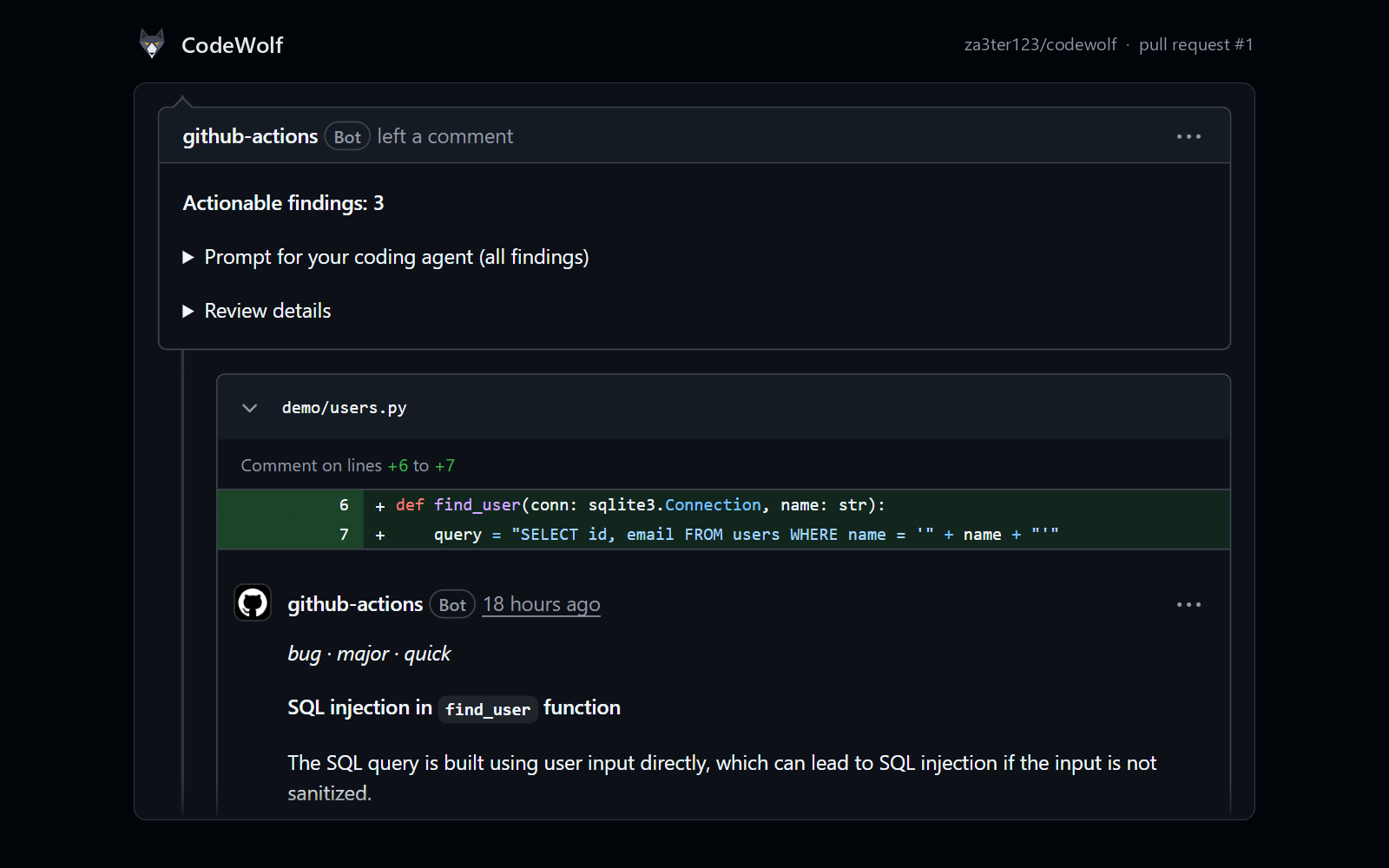
- Posts one review. Each inline comment starts with category, severity and effort, then the title, the explanation, a GitHub suggestion block so the fix is one click, and a collapsed prompt you can paste into a coding agent. The review body holds the count of actionable findings and collapsed sections for nitpicks, findings outside the diff, linter output, one combined agent prompt and the review details (profile, model, commit range, files). Findings it already posted are never repeated.
- If GitHub rejects a comment because its line is outside the diff (HTTP 422), the review is retried without it and the finding moves to the review body.
Chat: mention @codewolf in a pull request comment or in a review thread.
| Command | What it does |
|---|---|
@codewolf review | Review the commits pushed since the last review |
@codewolf full review | Review the whole pull request again |
@codewolf pause / resume | Stop or restart automatic reviews on this pull request |
@codewolf summary | Regenerate the summary comment |
@codewolf configuration | Show the settings in use (keys are never shown) |
@codewolf help | List the commands |
@codewolf <anything else> | A question, answered from the diff (and the review thread when asked inside one) |
Comments from bots are ignored. By default, commands and questions are accepted from the repository owner, members, collaborators, contributors and the pull request author. On a public repository that uses paid API keys, this means anyone who has had one pull request merged (a contributor), or anyone who opens a pull request and comments on it, can spend your keys with @codewolf. To restrict it, list who may run commands in .codewolf.yaml:
review:
  auto:
    commandAccess: [OWNER, MEMBER, COLLABORATOR]   # default: [OWNER, MEMBER, COLLABORATOR, CONTRIBUTOR, AUTHOR]
The values are GitHub author associations, plus AUTHOR for the pull request author.
CodeWolf only trusts its own markers (the hidden comments that record the reviewed commit and the paused state) in comments written by a bot account, and it neutralizes marker-like text in model output and quoted questions. Use the default github-token or a GitHub App token; with a personal access token the summary is not recognized as CodeWolf's own and every run starts over.
The action reads .codewolf.yaml from the base branch of the pull request, not from the pull request itself, so a pull request cannot change which server your API keys are sent to. A config change takes effect once it is merged. If the file cannot be read for any reason other than not existing, the action uses default settings and prints a warning; it never falls back to the checked-out copy.
Inputs:
| Input | Default | Description |
|---|---|---|
github-token | ${{ github.token }} | Token for reading the pull request and posting comments |
provider | from config | anthropic, openai, gemini, ollama or claude-code |
model | provider default | Model id |
api-keys | One or more keys, comma or newline separated. Pass them from secrets | |
base-url | provider default | Provider endpoint, for example an OpenRouter or Ollama URL |
profile | chill | quiet, chill or assertive |
config | .codewolf.yaml | Path to the config file |
language | en | Language for the review text |
Pull requests from forks get a read-only token and no secrets from GitHub, so the example workflows skip them. A maintainer can still comment @codewolf review on such a pull request: comment events run with the base repository's token.
Multiple keys and the fallback chain
Every provider has a key pool. Keys come from --keys a,b,c (the api-keys input in the action) or from environment variables: ANTHROPIC_API_KEY(S), OPENAI_API_KEY(S), GEMINI_API_KEY(S), OPENROUTER_API_KEY(S) and CODEWOLF_API_KEYS. The plural forms take a comma or newline separated list. Keep keys out of .codewolf.yaml; it is committed to the repository.
- Requests rotate round-robin across healthy keys.
- A
429cools that key for theretry-aftertime (60 seconds if the provider gives none) and the request moves to the next key at once. - A
401or403disables the key for the rest of the run. - A
5xxor network error moves to the next key, with at most two retries per key per request.
When every key of a provider is cooling or disabled, CodeWolf falls through to the next provider in the providers: list. A run fails only when the whole chain is exhausted, and the error names each provider and why it failed. A typical chain is a paid API first, a cheaper OpenAI-compatible endpoint second, and a local Ollama model last, so a review always finishes.
Keys are never printed in full. Logs show them masked, like sk-...abcd.
Configuration: .codewolf.yaml
Run codewolf init for a commented starter file. Every field is optional; CLI flags and action inputs override it.
profile: chill            # quiet: critical only. chill: critical and major, few nits. assertive: everything
language: en
providers:                # tried in order
  - name: anthropic
    model: claude-sonnet-5-5       # keys come from the environment or --keys, never from this file
  - name: openai
    baseUrl: https://openrouter.ai/api/v1
    model: qwen/qwen3-coder
  - name: ollama
    model: qwen2.5-coder:7b
review:
  exclude: ["**/*.lock", "dist/**"]    # lockfiles, dist/, minified files and binaries are excluded by default
  pathInstructions:
    - path: "src/api/**"
      instructions: "Check authz on every handler."
  failOn: critical         # CLI exits 1 if any finding is at or above this severity
  guidelines: true         # include CLAUDE.md, AGENTS.md, .cursorrules excerpts as review context
  auto:                    # GitHub Action only
    enabled: true          # false: review only on @codewolf review
    drafts: false          # true: review draft pull requests too
    baseBranches: []       # e.g. [main, "release/*"]; empty means every base branch
    ignoreUsers: []        # pull request authors to skip, e.g. [renovate]
    commandAccess: [OWNER, MEMBER, COLLABORATOR, CONTRIBUTOR, AUTHOR]   # who may use @codewolf
tools:                     # local linters whose output is merged into the review; missing tools are skipped
  ruff: true
  eslint: true
  semgrep: true
  gitleaks: true
A .codewolf.yaml found in the repository is treated as untrusted, because anyone who can open a pull request or share a repository can write one:
env:NAMEkey references in it are ignored with a warning. They only work in a file you pass yourself with--config.- Keys from your environment or
--keysare sent only to the provider's official host (api.anthropic.com,api.openai.com,openrouter.ai,generativelanguage.googleapis.com) or to a base URL you chose yourself with--base-urlor theCODEWOLF_BASE_URLenvironment variable (thebase-urlinput in the action). If the file points a provider at any other server, that provider gets no keys and CodeWolf prints a warning. Keyless local providers such as Ollama are unaffected. - A
commandfor theclaude-codeprovider is ignored. Set the binary with--claude-binorCODEWOLF_CLAUDE_BIN. - Local linters run with their own project config. ESLint in particular loads the repository's JavaScript config file, so pass
--no-toolswhen reviewing a repository you do not trust.
Learnings are reviewer preferences in .codewolf/learnings.md, one per line. Add them with codewolf learn "prefer early returns" and commit the file; both the CLI and the action read it.
What the reviewer looks for: bugs, security problems (injection, broken authorization, hardcoded secrets, unsafe deserialization, SSRF, path traversal), performance, maintainability and missing tests. For a hot path it may propose a rewrite in a faster language or library, always with a stated reason. A built-in scanner that uses no model flags hardcoded secrets on added lines (AWS key ids, private key blocks, GitHub, Slack, OpenAI, Anthropic and Google key shapes, high-entropy api_key = "..." values). Findings on files that are not in the diff are dropped before you see them. Findings on a changed file but on an unchanged line go to a separate outside the diff list: never posted inline, never counted in the exit code, and dropped when the line is past the end of the file.
Claude Code plugin
Inside Claude Code:
/plugin marketplace add za3ter123/codewolf
/plugin install codewolf@codewolf
Then run /codewolf:codewolf (optionally with flags such as --base main). It runs codewolf review --format plain, fixes the critical and major findings, re-runs up to three rounds, and reports what it fixed and what it left. The plugin also ships a codewolf skill that tells Claude when to run the reviewer and how to read its output.
An optional Stop hook blocks Claude from finishing while critical findings remain in uncommitted changes. It is off by default; see integrations/claude-code/hook-example/ to turn it on.
CodeWolf and CodeRabbit
CodeRabbit is a mature hosted product with features CodeWolf does not have. CodeWolf covers the core review loop, costs nothing beyond the model you choose, and is open about the gaps.
| CodeWolf | CodeRabbit | |
|---|---|---|
| Price | Free. You pay your model provider, or nothing with a local model | $24 to $30 per developer per month on the base Essentials plan (pricing, October 2026) |
| Review limits | Only your provider's rate limits; many keys rotate past them | Reviews per hour are capped by plan |
| PR summary, walkthrough, effort estimate | Yes | Yes |
| Sequence diagrams | Yes, when the model finds a real call flow | Yes |
| Inline findings with one-click suggestions | Yes | Yes |
| Prompts for coding agents | Yes, per finding and combined | Yes |
| Incremental review of new commits | Yes | Yes |
| Chat and commands in PR comments | Yes, @codewolf | Yes |
| Pause, resume, auto-review rules | Yes | Yes |
| Local CLI review for coding agents | Yes | Yes |
| Learnings | Yes, from a file you commit | Yes, learned from chat and stored by the service |
| Linter and scanner output in the review | Yes: ruff, eslint, semgrep, gitleaks when installed, plus a built-in secret scanner | Yes, dozens of bundled tools |
| Open source | Yes, MIT | No |
| Your own API keys, many at once, rotation | Yes | No |
| Provider fallback chain | Yes | No |
| Local models (Ollama), zero-key CI | Yes | No |
| Runs on your Claude subscription | Yes, claude-code provider | No |
| Code stays on your runner (with a local model) | Yes | No, hosted service |
| GitLab, Bitbucket, Azure DevOps | Not yet, GitHub only | Yes |
| Codebase-wide context (code graph, related files) | No, the diff only | Yes |
| Docstring and unit test generation | No, by design: your coding agent writes them | Yes |
| Issue tracker integration (Jira, Linear) | No | Yes |
| IDE extension | No, by design: it installs into your coding agent | Yes |
| Hosted app with dashboard and org settings | No | Yes |
Review quality depends mostly on the model you point CodeWolf at. A small local model catches obvious bugs; a frontier model catches much more.
Other open-source reviewers are worth a look too. PR-Agent from Qodo is the most established, with many tools and support for several git hosts. Shippie is a lighter TypeScript reviewer that runs in CI. CodeWolf's focus is multi-key rotation with a provider fallback chain, zero-key local models, and a review loop built for coding agents.
What CodeWolf will not do
CodeWolf is a tool that runs inside your own agent and your own CI. These features of hosted review services are left out on purpose:
- Accounts, login, organizations, SSO and regions. There is no service to log in to.
- Plans, credits, billing, usage caps and seat checks. Your only limits are your model provider's.
- Telemetry of any kind: no analytics, no crash reporting, no uninstall pings, no update checks. CodeWolf only talks to the model and GitHub endpoints you configure.
- A one-click GitHub App, hosted webhooks or a web dashboard. The Action runs in your own workflow with your own token.
- Cloud agent tasks and uploading your agent session transcripts. Your sessions stay on your machine.
- A VS Code extension UI. Your coding agent is the interface.
- A self-hosted server mode. The CLI and the Action need no server.
- Perforce and jj support. CodeWolf reads git diffs only.
- Stats heatmaps. They measure people, and a reviewer has no use for them.
- Docstring and unit test generation. Your host agent already writes those well; CodeWolf hands it the findings instead.
How this was researched
The v0.2 agent features (the fix hand-off, applying suggestions, installing into agents, the commit hook, doctor, agent detection and pulling PR comments) were chosen by statically inspecting CodeRabbit's public VS Code extension 0.23.0 and CLI 0.9.0 with the REA reverse-engineering tool, to list which features they offer. Only that feature list was used. No CodeRabbit code, prompts, endpoints or wire formats were copied, and CodeWolf never calls CodeRabbit services. Everything here is written from scratch in our own words.
Clean-room statement
CodeWolf is a clean-room implementation. It was built from CodeRabbit's public documentation, its publicly observable behavior on pull requests, and the feature inventory described above. No CodeRabbit source code, prompts, endpoints or private APIs were copied or called. CodeWolf is not affiliated with or endorsed by CodeRabbit.
Development
npm ci
npm run build      # typecheck, then bundle dist/cli.js and dist/action.js
npm test           # node --test, no network
dist/ is committed because the GitHub Action runs it directly. CI fails if dist/ is out of date, so run npm run build before you commit.
License
MIT License. Copyright (c) 2026 CodeWolf contributors. See LICENSE.